
Loading...
Serving Danbury, CT and surrounding areas. (475) 218-4243
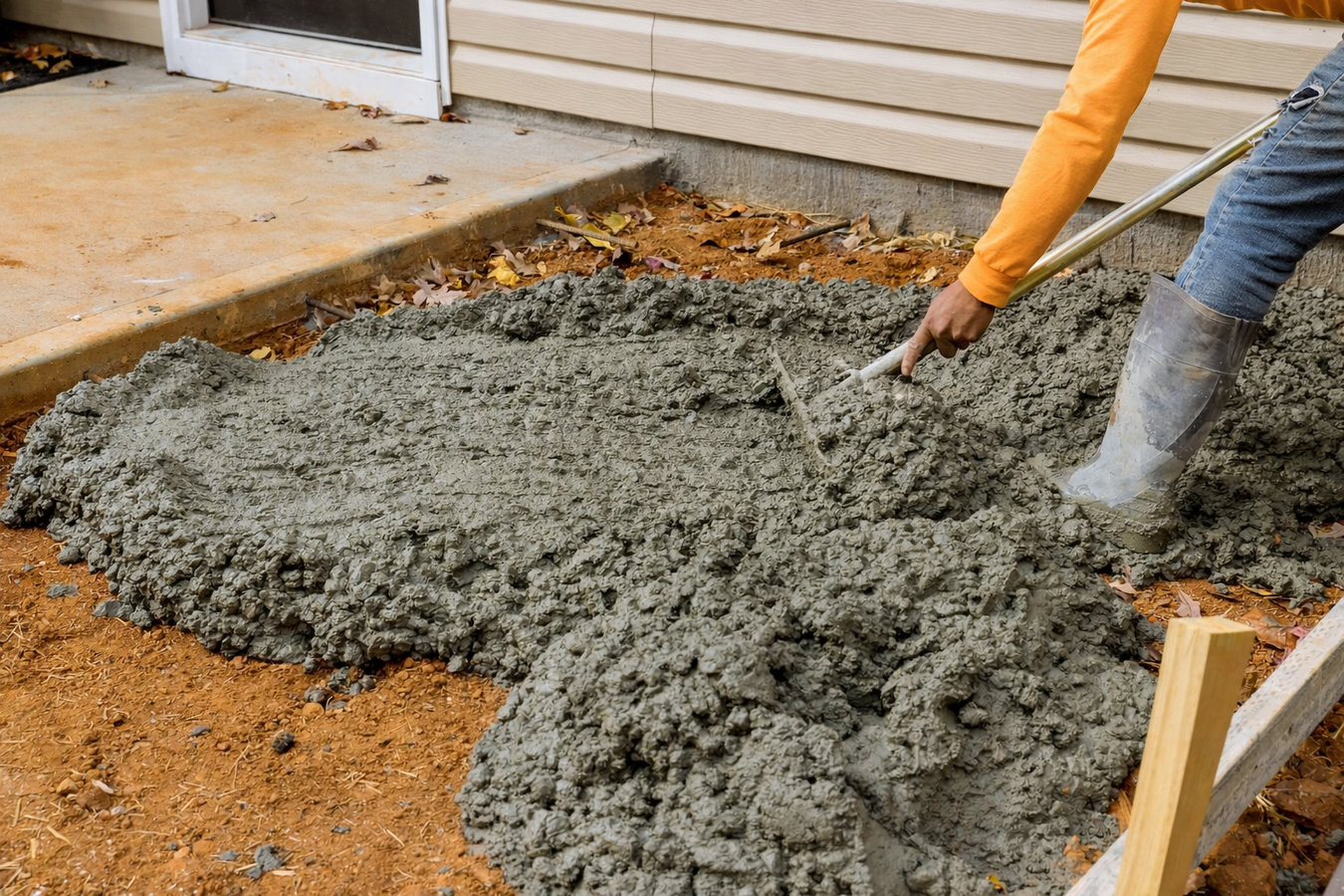
Sunken concrete is a safety hazard and only gets worse each winter. We lift settled slabs back to level without tearing out your existing concrete.
Foundation raising in Danbury lifts sunken concrete slabs back to their original level by pumping a material beneath the slab through small drilled holes - most jobs on a single stoop, patio, or garage floor section are finished in a few hours, the same day you call.
If your front steps have developed a noticeable tilt or a section of your driveway sits lower than the rest, you are not imagining it - the soil underneath has shifted. In Danbury, that happens regularly because of the area's glacially deposited ground and the repeated freeze-thaw cycles that come with every Connecticut winter. Raising the slab costs a fraction of replacement and gets the problem solved the same day. If your concrete has deteriorated to the point where lifting will not hold, we can talk through concrete cutting and replacement as well.
Watch for these warning signs, especially after a Danbury winter.
If one side of your front steps, porch slab, or sidewalk panel sits clearly lower than the other, the soil underneath has shifted. In Danbury this often shows up in April and May after a full winter of freeze-thaw movement. A tilted slab near an entry is also a trip hazard, so it is worth acting on before the next icy season.
Puddles forming right against your foundation after rain may mean a concrete apron or slab has settled and is now directing water toward your home instead of away from it. Danbury's hilly terrain makes this especially common, and water that consistently runs toward your foundation can cause much bigger problems than just an uneven slab.
A crack that runs across your garage floor where one side sits higher than the other - a "step" crack - usually means the slab has settled unevenly. This is different from hairline surface cracks, which are normal. If you can feel a step when you walk across the crack or the crack has grown wider over the past year, have a contractor assess it before it gets worse.
If a gap has opened between your concrete stoop, driveway apron, or patio and the wall of your house, the slab has almost certainly dropped. Even a small gap lets water in, and in Danbury's climate that water freezes each winter and pushes the slab a little further away from the house every year.
We handle foundation raising for all types of residential concrete - front stoops, driveway aprons, garage floors, patio slabs, and basement entries. For most jobs we offer polyurethane foam injection, which uses small holes, cures in about 15 minutes, and adds virtually no weight to the soil underneath. The material does not shrink or wash away, which matters a great deal in Fairfield County's freeze-thaw winters. If foam injection is not the right fit for your situation, we can also discuss traditional mudjacking, which uses a cement-and-soil slurry and is often more cost-effective on larger flat areas.
Every raising job starts with an honest assessment. We look at the slab from multiple angles, check drainage patterns nearby, and try to understand why the soil moved before we drill a single hole. That step is what separates a repair that lasts from one that repeats itself in two winters. If the concrete has deteriorated past the point where raising will hold, we will tell you - and we can connect you with our concrete cutting and slab foundation building teams for a full replacement approach.
Best for homeowners who want a fast cure, minimal hole size, and long-lasting results through Connecticut's harsh winters.
A cost-effective option for larger flat slabs where upfront price is the priority and longer cure time is acceptable.
Suited for homeowners dealing with a tilted front stoop or uneven entry slab that has become a trip hazard or is letting water in.
Ideal for garages where a step crack has developed and one section of the floor sits noticeably lower than the rest.
Danbury sits on glacially deposited terrain - a mix of clay, sand, gravel, and compacted till left behind by retreating glaciers. That soil is notoriously inconsistent: one section of a yard can be dense and stable while a few feet away the ground is loose and prone to washing out. Combine that with Danbury winters that bring repeated freeze-thaw cycles from November through March, and you have a landscape that is hard on any concrete slab resting directly on the ground. Homes built in Danbury before 1980 - which describes a large share of the city's housing stock - were often placed on soil that was not compacted to modern standards, so their stoops, garage floors, and concrete aprons have had decades to settle. The American Concrete Institute recommends addressing settled slabs before water intrusion accelerates the underlying soil erosion.
Danbury's hilly terrain adds another layer of difficulty. On sloped lots - which are common throughout the city - rainwater and snowmelt run toward the foundation or pool near concrete slabs rather than draining away. Over time, that water erodes the soil beneath slabs and speeds up settling. We see this pattern regularly in neighborhoods across the city and in surrounding communities like Norwalk and Bridgeport, where similar glacial soil conditions and older housing stock create the same challenges. Proper drainage correction alongside the lifting work is often the difference between a repair that holds for a decade and one that needs to be redone in two years.
Here is exactly what to expect, from your first call to walking on a level slab.
Tell us what has sunk, roughly how far it has dropped, and whether you have noticed any cracks or drainage issues nearby. We reply within one business day and will let you know right away if it sounds like a case where raising is the right approach.
We walk the area with you, check the slab from multiple angles, and look at drainage patterns. You get a written estimate that explains the method, the scope, and the total cost - no pressure to sign on the spot.
The crew drills small holes through the slab, injects the lifting material, and watches the slab rise back to level. Most single-slab jobs are done the same day. You can watch the process from a safe distance if you like.
Drill holes are patched with a concrete mix before the crew leaves. For foam injection you can walk on the surface within an hour. We will tell you when it is safe to drive on a raised garage floor - typically within 24 hours.
Free written estimate. We reply within one business day. No pressure to commit.
(475) 218-4243We do not just push the slab back up and leave. Every job starts with an assessment of why the soil moved - drainage, erosion, or original compaction - so the repair is not back to square one by the next spring thaw.
We have worked on glacially deposited soil across Fairfield County - the same inconsistent mix of clay, gravel, and till that makes Danbury slabs settle unevenly. That local experience changes how we approach every job.
Most single-slab raising jobs in Danbury are completed in under eight hours from crew arrival to cleanup. You are not managing a multi-day project or living around a torn-up yard - the slab is level and the crew is gone the same day.
When a job requires a permit through the Danbury Building Department, we handle the paperwork so you do not have to navigate the process yourself. Permitted work is documented work, which matters when you sell your home.
Every one of those points comes back to the same thing: a repair that actually holds. We would rather earn repeat business by doing the job right than come back every two years to redo the same slab.
Precision cutting for driveway sections, basement wall openings, and damaged slab removal throughout Danbury.
Learn moreNew concrete slab construction from the ground up for garages, additions, and structural pads in Danbury.
Learn moreSpring is our busiest season - reach out now and lock in your spot before the schedule fills up.